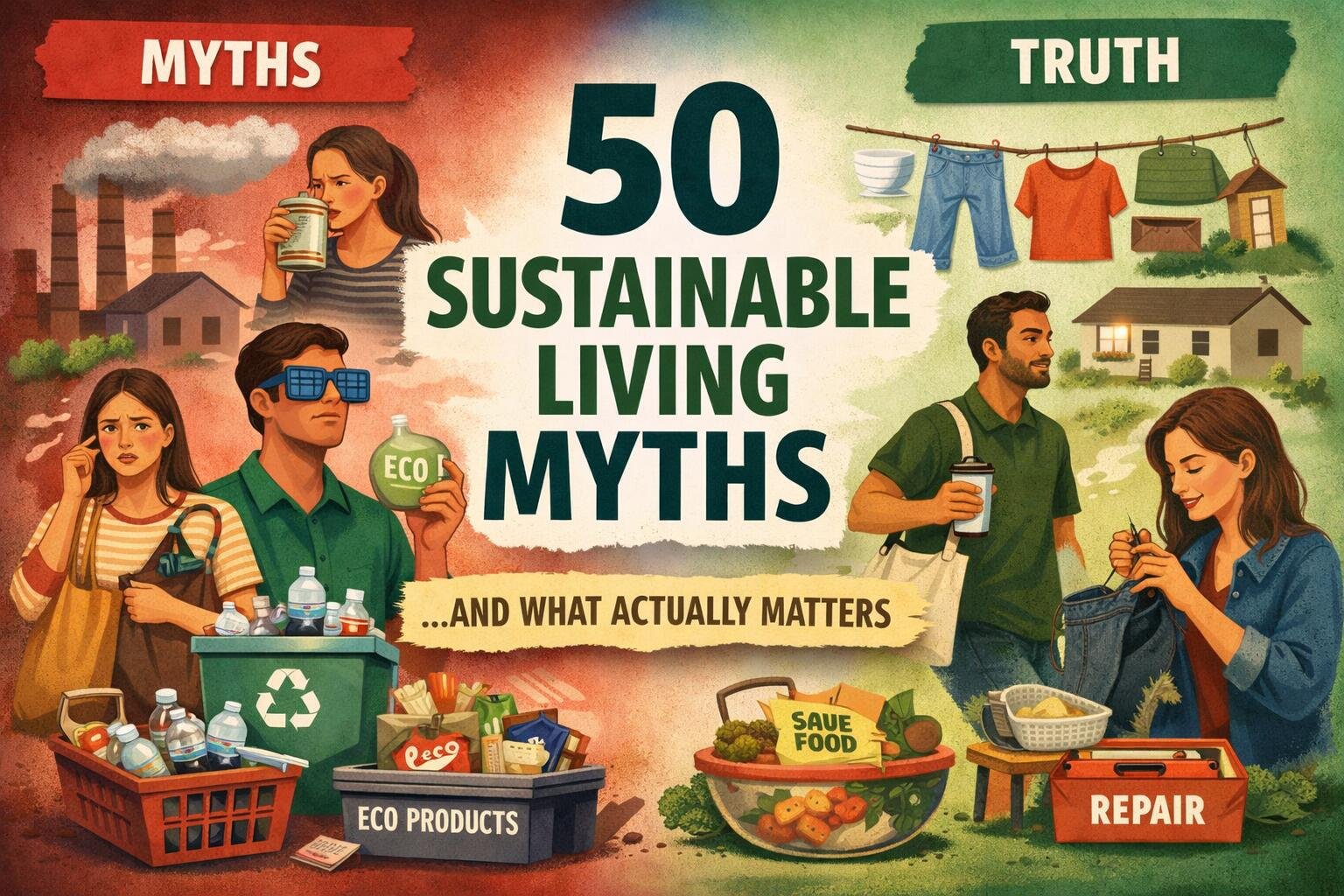
If you’ve ever tried to live more sustainably, you’ve probably felt overwhelmed. One article tells you to buy eco-friendly products. Another says go zero waste. Someone else insists you need solar panels, organic everything, and a minimalist home.
It’s confusing.
The truth is, a lot of advice around sustainable living is shaped by marketing, trends, or extreme interpretations. And when you follow those myths, you either end up spending more money than necessary or feeling like you’re never doing enough.
You don’t need to overhaul your entire life to live sustainably. You don’t need perfection. And you definitely don’t need to buy your way into it.
In this article, you’ll discover 50 common sustainable living myths and what actually matters instead, so you can focus on actions that reduce real impact, not just follow popular eco trends.
What Are Sustainable Living Myths?
Sustainable living myths are ideas that sound eco-friendly but do not always reduce real impact. Many are oversimplified or shaped by marketing rather than meaningful environmental change.
You might hear that buying eco-labelled products is enough, or that recycling solves everything, or that you must be completely zero-waste to matter.
These beliefs spread because they are simple and appealing. But real sustainable living focuses on reducing consumption, extending product life, and changing habits, not just following trends.
Why Sustainable Living Advice Is Often Misleading
A lot of sustainable living advice focuses on what you should buy next, eco-friendly swaps, upgraded appliances, organic alternatives, reusable kits. It sounds responsible, but it still keeps you in a cycle of consumption.
Marketing often presents sustainability as a product category instead of a behaviour shift. When the solution is always another purchase, the deeper issue, overconsumption, remains untouched.
Social media adds another layer. Perfect zero-waste kitchens and aesthetic minimalist homes can make sustainability look like a lifestyle brand rather than a practical mindset. That can make you feel like you are failing if your home does not look “eco enough.”
Real sustainable living is less visible. It is about buying less, using things longer, and questioning whether you need something at all. When advice ignores that, it becomes incomplete, and sometimes misleading.
10 Consumption Myths: Sustainability Is Not About Buying More
Many sustainable living myths are rooted in the idea that you need to purchase better products to reduce your impact. But replacing functional items still requires manufacturing, packaging, and transport, which increases resource use.
Here are 10 common consumption myths:
- You have to buy eco-friendly products to live sustainably.
- Replacing everything with “green” versions is better for the planet.
- Minimalism automatically equals sustainability.
- If it’s labelled eco, it must be environmentally responsible.
- Sustainable living requires a higher income.
- Organic products always have a lower carbon footprint.
- Buying reusable items fixes overconsumption.
- New sustainable brands are better than keeping old durable products.
- Aesthetic minimalist homes are more sustainable.
- You need to overhaul your lifestyle all at once.
What actually matters is reducing demand. Using what you already own for longer often has a lower environmental impact than replacing it with something marketed as sustainable. Real sustainability starts by questioning whether a purchase is necessary at all.
10 Waste & Recycling Myths: Reduction Comes Before Recycling
Recycling is often presented as the core of sustainable living. While it helps manage waste, it does not reduce production. Many myths focus on disposal instead of prevention.
Here are 10 common waste and recycling myths:
- Recycling is enough to live sustainably.
- If something is recyclable, it is environmentally harmless.
- Biodegradable means it breaks down anywhere, anytime.
- Compostable products decompose easily in all conditions.
- Paper is always better than plastic.
- Cloth bags have no environmental footprint.
- Zero waste means producing absolutely no trash.
- Individual household waste does not matter compared to industry.
- Switching materials solves the waste problem.
- Waste management is more important than reducing consumption.
What actually matters is reducing waste before it exists. Preventing unnecessary purchases, reusing what you already have, and lowering overall consumption reduce impact more effectively than relying on recycling systems.
10 Food & Diet Myths: Sustainability Is Not All-or-Nothing
Food choices are often framed in extreme ways. You’re told you must follow a perfect diet or eliminate entire food groups to be sustainable. But sustainability in food is more about patterns than perfection.
Here are 10 common food and diet myths:
- You must go fully vegan to live sustainably.
- Organic food automatically has a low environmental impact.
- Imported “superfoods” are always better for the planet.
- Local food is always sustainable.
- Plant-based processed substitutes are automatically eco-friendly.
- Reducing meat slightly does not make a difference.
- Food packaging is the biggest climate issue in the food system.
- Buying in bulk is always sustainable.
- Seasonal eating is outdated and unnecessary.
- Household food waste is insignificant compared to industry.
What actually matters is reducing food waste, moderating high-impact foods, and eating in a way that lowers overall demand. Consistent, realistic adjustments often have more impact than extreme dietary shifts that are hard to maintain.
10 Energy & Home Myths: Technology Is Not the First Step
When people think about sustainable living, they often imagine solar panels, smart thermostats, or major renovations. While technology can help, it is not the starting point for most households.
Here are 10 common energy and home myths:
- You need solar panels to reduce your energy impact.
- Smart homes are automatically sustainable homes.
- Energy-efficient appliances fix high consumption habits.
- Turning off lights is the biggest energy-saving action.
- Sustainable living requires home renovation.
- Bigger homes can be fully sustainable with upgrades.
- Technology alone will solve climate change.
- Air conditioning use has minimal environmental impact.
- Energy-saving gadgets replace mindful behaviour.
- Renting means you cannot live sustainably.
What actually matters is reducing overall energy demand through daily habits, mindful usage, and avoiding unnecessary upgrades. Behaviour change often reduces impact more effectively than technology alone.
10 Lifestyle & Culture Myths: Sustainability Is Not About Perfection
Some of the most powerful sustainable living myths are cultural. They shape how you feel about your efforts and whether you even start.
Here are 10 common lifestyle and mindset myths:
- One person cannot make a difference.
- Sustainable living means sacrificing comfort.
- You have to be perfect to be credible.
- If you still create waste, your efforts do not count.
- Sustainable living takes too much time.
- Being eco-conscious makes you extreme.
- Sustainability is just a passing trend.
- Talking about consumption does not change anything.
- Convenience and sustainability cannot coexist.
- Sustainable living is about image, not impact.
What actually matters is consistency over perfection. Sustainable living is not about being flawless. It is about reducing harm where you can, improving gradually, and normalising conscious choices in everyday life.
According to the United Nations Environment Programme, improving resource efficiency and reducing overall consumption are central to lowering environmental impact.

What Actually Matters in Sustainable Living
After breaking down these sustainable living myths, the pattern becomes clear. Most misconceptions focus on products, perfection, or visibility. Real impact comes from something much simpler.
What actually matters is reducing overall consumption. Buying less prevents manufacturing, packaging, and transport emissions before they happen.
It also means extending the life of what you already own. Repairing early, reusing consistently, and resisting unnecessary upgrades reduce demand more effectively than constant replacements.
Consistency matters more than intensity. A few habits practised long term reduce more impact than dramatic short-term changes.
And finally, awareness matters. When you question purchases, notice waste patterns, and make slower decisions, sustainable living becomes practical instead of overwhelming.
Sustainability is not about looking eco-friendly. It is about lowering your footprint in ways that last.
FAQs About Sustainable Living Myths
What are the biggest sustainable living myths?
The biggest sustainable living myths are that you need to buy eco-friendly products, recycle everything, or live completely zero-waste to make a difference. In reality, reducing how much you consume and using things longer usually matters more.
Is recycling enough to live sustainably?
Recycling helps, but it is not enough on its own. It deals with waste after it is created. Living sustainably is more about reducing and reusing so that less waste is produced in the first place.
Do you need to buy eco-friendly products to be sustainable?
No, you do not need to buy eco-friendly products to live sustainably. Often, the most sustainable choice is continuing to use what you already have instead of replacing it.
Is sustainable living expensive?
Sustainable living does not have to be expensive. When it focuses on buying less, reducing food waste, and cutting unnecessary energy use, it can actually help you save money.
Can small changes really make a difference?
Yes, small changes can make a difference when they are consistent. Habits like delaying purchases, reducing waste, or walking short distances add up over time and lower overall demand.